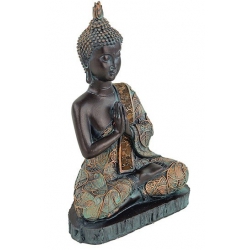
Buddha Thailand Sukuthai Style 18111
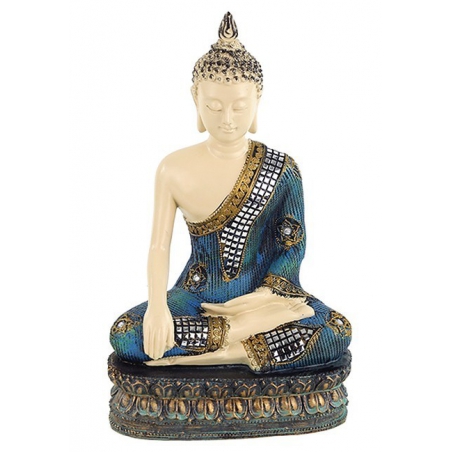
The most common Buddha statue in Thai temples is cross-legged, with the left hand in the lap, and the right hand touching the ground with the palm facing inward toward the Buddha. This posture is known as "invoking the earth" to attest to the Buddha's moment of enlightenment.
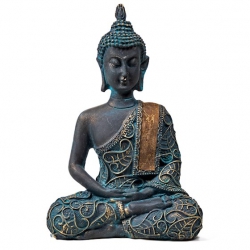
He sits in the Padmasana position (Lotus Pose). The legs are crossed, and this is also commonly known as a meditation pose.
Right hand down with the fingers pointing downward and the palm facing the body (bhumisparsha mudra). This pose symbolizes the "touch of the earth." The pose refers to the moment the Buddha attained enlightenment and called upon the Earth as his witness. This pose also typifies the heavenly Buddha of the East, Akshobhaya.
Sukhothai originated in the 13th century and was the first Thai kingdom. Sukhothai is also the founder of the Thai alphabet and language. Sukhothai is located 430 km north of Bangkok. Sukhothai Buddhas are recognizable by the flame on their heads, which symbolizes the enlightenment they achieved (a sign of enlightenment) and is the most common Buddha image in Thai temples.
Buddha Thailand Sukuthai Style 18111
Dimensions: approximately 29.5 cm high, approximately 18 cm wide
Color: white with green/blue robe
Material: Polyresin
Hand-painted with inlaid mosaic mirrors